3 Day Gym Split: Build Muscle Without Burning Out

A 3 day gym split is a structured training program that divides your weekly workouts across three sessions, targeting different muscle groups each day while building in dedicated recovery time. This approach, formally called a weekly training split in exercise science, delivers a proven balance of volume, intensity, and rest that works for both beginners and intermediate lifters. The three most common formats are Push-Pull-Legs (PPL), Upper/Lower/Full Body hybrid, and Full Body 3×. Each one solves a different problem depending on your training age, goals, and how fast you recover.
What is a 3 day gym split and why does it work?
A 3 day gym split works because it gives each muscle group enough stimulus to grow and enough time to recover before the next session. Recovery days are not downtime. They are the windows where muscle repair and adaptation actually happen. Skipping rest is not dedication. It is the fastest way to stall progress.
The structure also solves a common scheduling problem. Three sessions per week fit into almost any lifestyle, which means you actually show up. Adherence is the single biggest predictor of long-term results, and a 3 day a week workout plan removes the excuse of not having time.

A 3 day split delivers balanced muscle and strength gains when paired with progressive overload and adequate protein intake. That combination, not training frequency alone, is what drives results. Three well-executed sessions beat five sloppy ones every time.
What are the main types of 3 day gym splits?
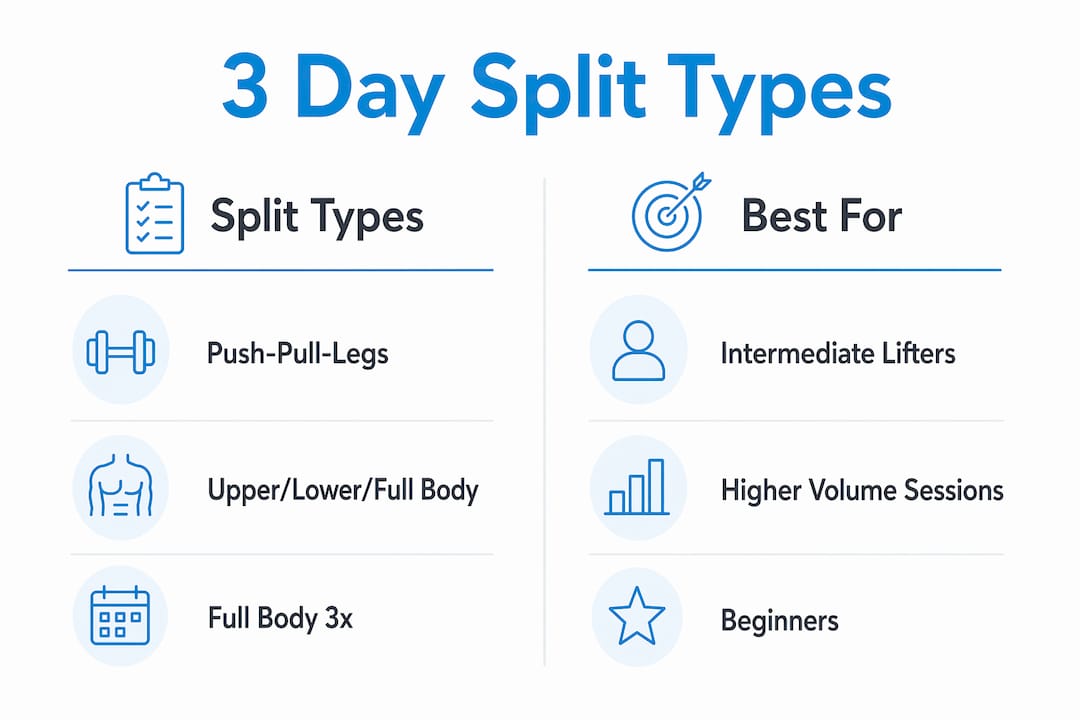
Three formats dominate the 3 day strength training split category. Each has a different logic, and choosing the wrong one for your level is the most common mistake beginners make.
Push-Pull-Legs (PPL)
The PPL split groups muscles by movement pattern. Push day trains chest, shoulders, and triceps. Pull day trains back, biceps, and rear delts. Leg day covers quads, hamstrings, calves, and glutes. Each muscle group gets one focused session per week with high per-session volume. This format suits intermediate lifters who already know their compound lifts and want to specialize.
Upper/Lower/Full Body hybrid
The Upper/Lower/Full Body hybrid runs two split days followed by one full body day. It gives you higher per-session volume than a pure full body program while still hitting every muscle group with decent frequency. Four recovery days per week make burnout unlikely. This split works well for lifters transitioning out of beginner full body programs.
Full Body 3×
Full Body 3× trains every major muscle group in every session. Beginners benefit most from this format because it maximizes neural adaptation through compound lifts and linear progression. The standard approach runs 8–12 weeks before you reassess. Common exercises are squat, bench press, and deadlift, performed in 3–5 sets of 3–5 reps with weight added every session.
| Split type | Best for | Volume per session | Muscle frequency | Recovery days |
|---|---|---|---|---|
| Push-Pull-Legs | Intermediate lifters | High | Once per week | 4 per week |
| Upper/Lower/Full Body | Transitioning lifters | Moderate to high | 1–2× per week | 4 per week |
| Full Body 3× | Beginners | Moderate | 3× per week | 4 per week |
How do you choose the right 3 day split for your goals?
The best 3 day split depends on your training age and recovery capacity. Beginners need high-frequency compound movements to build the motor patterns and neural efficiency that make lifting feel natural. Intermediate lifters need more volume per muscle group to keep growing, which is where specialized splits earn their place.
Match your split to your goal using these guidelines:
- Muscle gain (beginner): Full Body 3× with compound lifts and linear progression
- Muscle gain (intermediate): Push-Pull-Legs with focused hypertrophy volume per session
- Strength focus: Full Body 3× or Upper/Lower/Full Body hybrid with heavier loads and lower reps
- General fitness: Upper/Lower/Full Body hybrid for balanced development without excessive fatigue
- Limited recovery: Upper/Lower/Full Body hybrid, which spreads intensity across session types
Recovery capacity is not fixed. Sleep quality, stress levels, nutrition, and training intensity all affect how fast you bounce back. If you feel sore going into every session, your volume or intensity is too high for your current recovery ability.
Pro Tip: If you have been training full body for 8–12 weeks and your progress is slowing, that is the signal to move to a split. Do not switch earlier just because a split looks more advanced.
How to structure and execute your 3 day lifting schedule
Scheduling is straightforward. Place a rest day between each training session when possible. Monday, Wednesday, Friday is the classic layout. Tuesday, Thursday, Saturday works just as well. The exact days matter less than the spacing.
A sample week for each split looks like this:
- Full Body 3×: Monday (full body), Wednesday (full body), Friday (full body)
- Push-Pull-Legs: Monday (push), Wednesday (pull), Friday (legs)
- Upper/Lower/Full Body: Monday (upper), Wednesday (lower), Friday (full body)
Exercise selection follows one rule: build around compound lifts. Squats, deadlifts, bench press, overhead press, and rows move the most muscle mass and drive the most adaptation. Isolation work like curls and lateral raises fills in the gaps after the heavy work is done.
Intensity should replace volume in a PPL routine, with sessions capped at 45–60 minutes. Recommended exercises include overhead press, deadlift, weighted pull-ups, and squats, performed in 3 sets of 6–8 reps. Longer sessions with more exercises rarely produce better results. They produce more fatigue.
| Split day | Primary exercises | Sets | Reps |
|---|---|---|---|
| Push | Bench press, overhead press, tricep dips | 3–4 | 6–10 |
| Pull | Deadlift, barbell row, weighted pull-ups | 3–4 | 5–8 |
| Legs | Squat, Romanian deadlift, leg press | 3–4 | 6–10 |
| Full body | Squat, bench press, row, overhead press | 3 | 5–8 |
Progressive overload is the engine behind all of this. Add weight when you can complete all reps with clean form. If you hit the top of your rep range across all sets, add 5 lbs the next session. Tracking this in real time, rather than guessing, is what separates lifters who progress from those who plateau. A progressive overload tracker removes the guesswork from session to session.
Pro Tip: Log your exact weights and reps every session. Memory is unreliable. Written records make progression automatic.
Common mistakes that derail a 3 day split routine
The biggest mistake is treating rest days as wasted time. Training 3× per week with high intensity and smart rest produces better results than training five or six days with moderate effort. More sessions do not mean more muscle. More recovery means more muscle.
Watch for these specific errors:
- Skipping the deload: After 6–8 weeks of hard training, one lighter week prevents accumulated fatigue from killing your progress
- Rushing progression: Adding too much weight too fast leads to form breakdown and injury, not faster gains
- Ignoring nutrition: A 3 day weight training split cannot outwork a caloric deficit if your goal is muscle gain
- Inconsistent scheduling: Training Monday, then waiting until the following Saturday, then Tuesday creates uneven recovery and stalls adaptation
- Copying advanced programs: A PPL routine designed for an experienced lifter has too much volume for someone six weeks into training
Missing a workout does not mean skipping it or doubling up the next day. Shift the workout days forward and continue the cycle. A rolling schedule is one of the real strengths of a 3 day split. It keeps structure without punishing you for life getting in the way.
Signs you need to adjust your split or volume include persistent soreness that does not clear between sessions, declining performance on lifts you were previously progressing, and poor sleep or low motivation. These are not signs of weakness. They are data points telling you to back off.
Pro Tip: Swap an exercise, not the entire program, when something stops working. Change one variable at a time so you know what made the difference.
Key Takeaways
A 3 day gym split works best when the format matches your training age, your sessions are built around compound lifts, and progressive overload is tracked consistently every week.
| Point | Details |
|---|---|
| Match split to training age | Beginners use Full Body 3×; intermediate lifters use PPL or Upper/Lower/Full Body hybrid. |
| Prioritize compound lifts | Squat, deadlift, bench press, and row drive the most adaptation per session. |
| Track progressive overload | Log weights and reps every session to make progression automatic, not accidental. |
| Treat rest days as training | Recovery days are when muscle repair happens; skipping them slows growth. |
| Roll with missed sessions | Shift the schedule forward instead of doubling up or skipping when life intervenes. |
Why I think most lifters overcomplicate their 3 day split
After watching hundreds of lifters cycle through programs, the pattern is clear. The people who make the most consistent progress are almost never running the most complex split. They pick a format that fits their schedule, show up three times a week, and add weight when they can. That is the whole system.
The lifters who stall are usually the ones who switch programs every four weeks, add extra sessions because they feel guilty on rest days, or copy a PPL routine from an advanced lifter before they have built the base to handle that volume. Complexity feels like progress. It rarely is.
My honest recommendation: if you are in your first year of lifting, run Full Body 3× for at least 12 weeks before touching a specialized split. The neural adaptations you build in that window make every future program more effective. Patience here is not passive. It is the most productive thing you can do.
Once you move to a split, track everything. Not because data is fun, but because memory is unreliable and progression requires precision. Gymdoe’s workout tracking features make this part of the process fast enough that it does not interrupt the session itself.
The best 3 day split is the one you will actually run for 12 weeks straight. Choose accordingly.
— Shelbe
How Gymdoe fits into your 3 day gym split
Gymdoe is built for exactly this kind of structured training. You can set up your full 3 day plan during onboarding, log sets, reps, and weight in real time, and track personal bests across every lift.
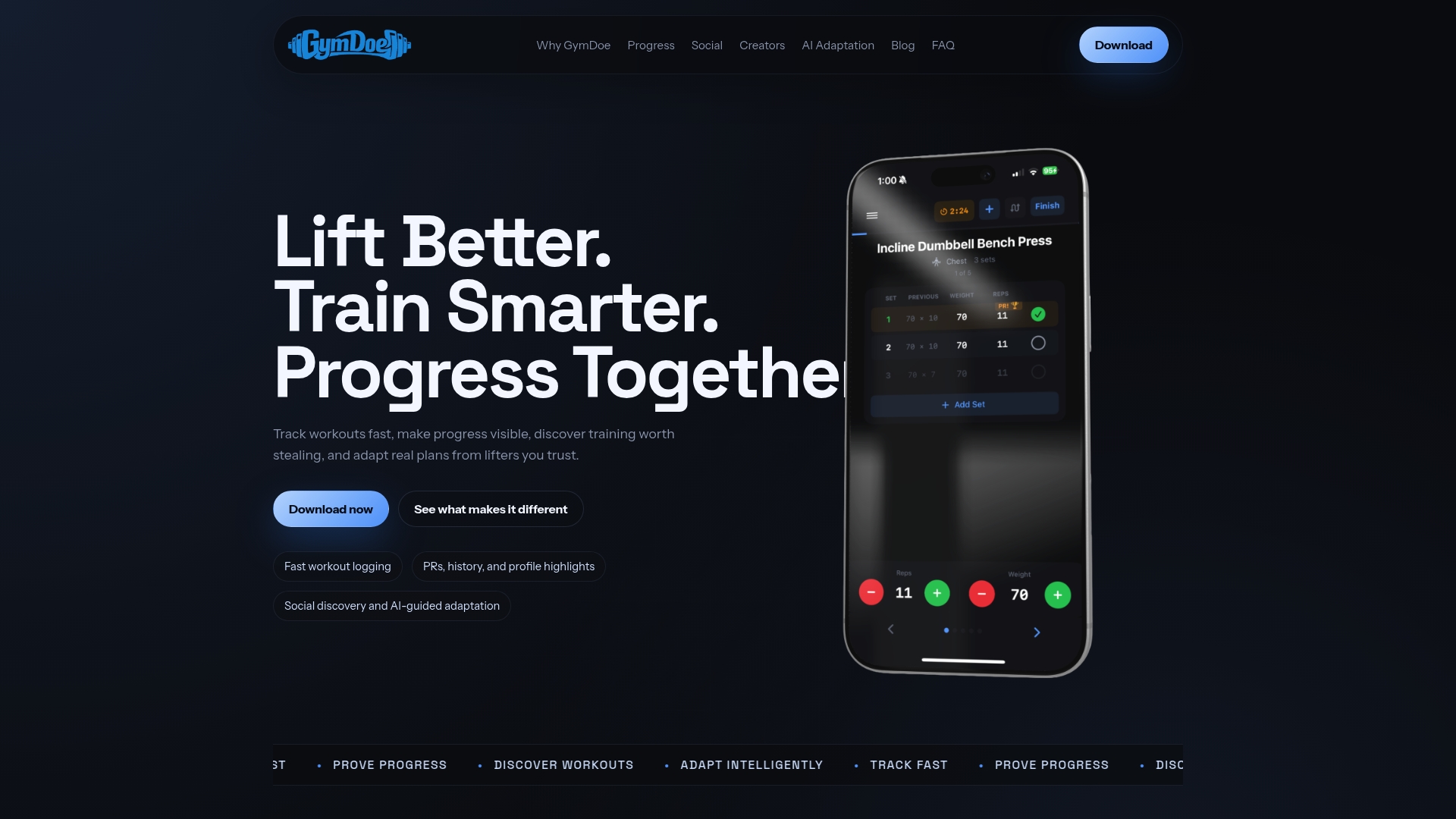
The app’s AI-powered adaptation lets you take a proven 3 day split from another lifter and reshape it around your equipment, experience level, and schedule. Progressive overload tracking shows you exactly when to add weight. Apple Health and Apple Watch integration keeps heart rate and recovery data in the same place as your lift history. If you want a structured 3 day plan that adapts as you grow, start with Gymdoe and build from there.
FAQ
What is a 3 day gym split?
A 3 day gym split is a weekly training program that organizes workouts across three sessions, targeting specific muscle groups or movement patterns each day while allowing recovery between sessions.
Is 3 days a week enough to build muscle?
Three days per week is enough to build significant muscle when sessions include compound lifts, progressive overload, and adequate protein intake. Balanced gains are achievable with this frequency for most beginners and intermediate lifters.
What is the best 3 day split for beginners?
Full Body 3× is the best starting point for beginners. It maximizes neural adaptation through compound lifts and linear progression, typically run for 8–12 weeks before moving to a specialized split.
What should I do if I miss a workout on my 3 day split?
Shift the missed session to the next available day and continue the cycle forward. Doubling up sessions or skipping the workout entirely both disrupt recovery and progress more than a simple schedule shift does.
How long should each session be on a 3 day split?
Sessions on a Push-Pull-Legs split should run 45–60 minutes. Full Body 3× sessions can be similar in length when focused on 3–5 compound movements with minimal isolation work added after.